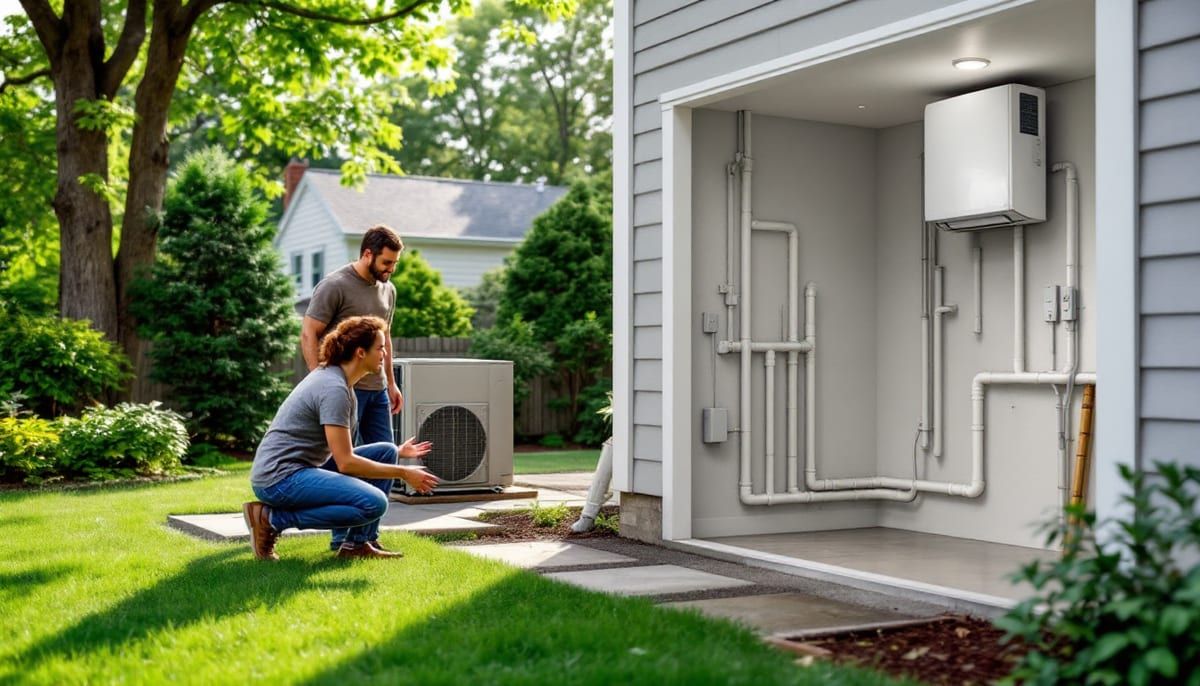
You've got a second-floor bedroom that turns into a sauna every July. Or a home addition that your existing system simply doesn't reach. Or maybe you bought a mid-century ranch in Scotch Plains that has baseboard heat and zero ductwork, which means every summer you're dragging a window unit out of the garage, propping it into place, and hoping the window seal holds. You've probably wondered if there's a better way. There is, and it's called a ductless mini-split. But the real question isn't whether mini-splits work. They do. The question is whether one makes sense for your specific situation, what it's actually going to cost, and how to get it installed the right way in New Jersey without dealing with permit headaches or a contractor who cuts corners. That's what this guide covers.
Where Do Mini-Splits Actually Make Sense?
Mini-splits are the right call when adding traditional ductwork isn't practical or affordable. That covers a lot of homes in Scotch Plains and Union County, particularly the mid-century ranches and colonials built in the 1950s through 1970s that have forced hot-air heating systems or baseboard heat but no central air infrastructure. If your home fits that description, you're not alone, and you're one of the best candidates for a mini-split installation.
Here's where these systems perform best:
- Homes with heating-only ductwork: Many older NJ homes have duct systems sized only for heat. Those ducts often can't handle the air volume required for central AC without major modifications to the air handler and trunk lines.
- Home additions and room conversions: A finished basement, converted garage, sunroom, or bump-out addition usually can't tie into the existing HVAC system without rebalancing the whole thing. A mini-split handles that space independently.
- Rooms that never feel right: If one bedroom is always ten degrees warmer than the rest of the house in August, it's usually a duct design issue. A mini-split for that zone solves the problem directly instead of fighting the existing system.
- No-ductwork homes: Houses with only baseboard heat or radiators. There's nothing to extend. A mini-split is the cleanest path to adding cooling without tearing up ceilings and walls.
If you're not sure whether your situation qualifies, here's a quick check you can do today: Look at your existing HVAC system and identify whether it has return and supply air vents in every room you want to cool. If rooms are missing vents entirely, adding ductwork to those spaces will be expensive. A mini-split is almost certainly the faster and cheaper path.
What Does Mini-Split Installation Cost in NJ?
The installed cost for a single-zone mini-split system in New Jersey generally lands in a range that many homeowners find competitive with other cooling options once you factor in the full scope of a duct extension project. Multi-zone systems that serve several rooms cost more, but the per-zone economics often still hold up against alternatives.
For current price ranges, see our mini-split and heat pump installation cost guide.
Several factors drive the final number:
- Number of zones (indoor units): A single-zone system serving one room is the most affordable option. Multi-zone setups connect multiple indoor units to one outdoor compressor and cost significantly more, though not as much as buying two or three separate systems.
- System capacity in BTUs: Larger rooms need larger units. Oversizing to "play it safe" is a common mistake that creates humidity problems (more on that below).
- Line set distance: The refrigerant line that runs between the outdoor compressor and the indoor unit has a standard included length. Longer runs cost more per additional foot. Houses where the outdoor unit needs to be placed far from the room being conditioned see higher labor costs.
- Electrical panel capacity: Mini-splits require a dedicated circuit. If your panel is already at capacity, you'll need an electrical upgrade as part of the project. That adds to the total but isn't optional.
- Brand tier: Premium brands cost more upfront but typically offer longer warranties and better long-term reliability. Budget brands may look appealing at the quote stage but can cost more in service calls later.
One thing to do right now if you're budgeting: Open your electrical panel door, without removing the cover, and count the open breaker slots. If you're running short, flag that for the contractor conversation upfront. It's better to know going in than to discover it mid-installation.
Do You Need a Permit for Mini-Split Installation in NJ?
Yes. Mini-split installation in Scotch Plains requires a permit from the Township Construction Official, and this requirement applies throughout Union County. This isn't optional, and any contractor who suggests skipping the permit process is a contractor you should not hire.
Here's why this matters beyond just following rules. If you sell your home and the buyer's inspector finds an unpermitted HVAC installation, you're looking at disclosure issues, price negotiations, or being required to remove and redo the work before closing. That's a much worse outcome than paying a permit fee upfront.
What the permit process actually looks like:
- Permit fees: In most Union County municipalities, these run a modest amount and are a routine part of any licensed contractor's project scope.
- Code compliance: Installations must comply with the International Mechanical Code and the International Energy Conservation Code as adopted by the New Jersey Department of Community Affairs. A licensed HVAC contractor knows these requirements and builds them into the installation process.
- Inspections: After installation, a municipal inspector will review the work. Your contractor schedules this. It's a normal part of the project timeline, not a complication.
When you're interviewing contractors, ask directly: "Will you pull the permit for this installation?" If the answer is anything other than yes, move on.
Is Mini-Split Sizing Really That Important?
Getting the BTU sizing right is as important as the brand you choose or the contractor you hire. An improperly sized system creates problems from day one, and those problems don't go away. They just wear out your equipment faster.
Two ways sizing goes wrong:
Undersized units run constantly. The compressor never shuts off because the system can't reach the set temperature. Energy bills go up, and the unit wears out ahead of schedule.
Oversized units are actually the more common mistake, and they create a specific problem in New Jersey's summers. When a unit is too large for a space, it cools the air temperature down quickly and shuts off before it's run long enough to pull humidity out of the air. You end up with a room that feels clammy and uncomfortable even at 70 degrees. In NJ, where July and August humidity is real, this matters a lot.
The right sizing process is called a Manual J load calculation. It accounts for:
- Room square footage and ceiling height
- Insulation quality in walls, ceiling, and floor
- Window size, placement, and type
- Sun exposure and orientation of the room
- Local climate data for your specific area
If a contractor quotes you a system size without doing this calculation or at least asking detailed questions about the space, that's a problem. Square footage alone isn't enough.
When Should You Schedule the Installation?
Spring and early fall are the best times to book a mini-split installation in Union County. April, May, September, and October give you faster scheduling, more flexibility on installation dates, and time to test the system before you actually need it.
Here's the reality of HVAC scheduling in New Jersey. From June through August, contractors are fielding emergency cooling calls. Systems break during heat waves, and those calls jump the line. From December through February, it's heating emergencies. If you want a non-emergency installation done well and on your schedule, you're fighting for calendar space during those months.
Booking in shoulder seasons means:
- Faster turnaround from quote to installation
- More options for scheduling an installation day that works for you
- Your system is in and tested before summer or winter demand hits
- The installer isn't rushing to get to the next emergency call
If you're reading this in summer or winter and you need a mini-split now, don't wait. Just understand that scheduling may take longer and set your expectations accordingly. One thing you can do right now regardless of season: request a quote. Most licensed contractors will do a site visit and quote at no charge, so you'll at least know your numbers and be next in line when the schedule opens up.
Mini-Split vs. Extending Existing Ductwork
In many older New Jersey homes, extending the existing duct system into an addition or new space costs as much as a mini-split and delivers worse results. This is a comparison that surprises a lot of homeowners who assume ductwork is the "standard" solution.
Here's what a duct extension project actually involves when done correctly:
- Evaluating whether the existing air handler has enough capacity to serve additional square footage
- Potentially upsizing the air handler if it doesn't
- Running new trunk lines and branch ducts through finished ceilings or walls, which often means drywall work afterward
- Rebalancing the entire system so the new addition doesn't pull conditioned air away from existing rooms
That's not a quick or cheap project. And at the end of it, the new space is still tied to the same thermostat as the rest of the house. If someone wants the addition at 68 degrees and the main thermostat is set to 72, you've got a conflict.
A single-zone mini-split serving the same addition can typically be installed in one day. It has its own thermostat or remote. It doesn't affect the rest of your system. And for finished basements or garage conversions in particular, it's often the only practical path that doesn't involve major structural disruption.
The ductwork extension does make sense in some situations: if your existing system is already oversized, if the new space connects easily to existing trunk lines, and if you prefer a unified system. A licensed contractor can assess both options honestly. If someone is pushing one approach without walking through both, ask why.
Why Choose Vanguard Service NJ?
Vanguard Service NJ is a licensed plumbing and HVAC contractor based in Scotch Plains, serving Union County and the surrounding communities. We work on the types of homes that are common in this area: mid-century builds, ranches, colonials, homes with older HVAC infrastructure, and newer additions that need independent climate control. We pull permits, do proper load calculations, and give you a straight answer on whether a mini-split is actually the right move for your situation or whether another approach makes more sense.
Our HVAC services cover mini-split installation, system sizing, and ongoing maintenance. If you're also dealing with heating, cooling, or comfort issues throughout the rest of your home, we can look at the full picture. Check out our customer reviews to hear from homeowners in the area, and visit our service area page to confirm we cover your town. If you're working with a budget, we also offer financing options worth looking at before you decide.
The Bottom Line
Here's what matters: A ductless mini-split is the right solution for a specific set of situations common in Union County and Scotch Plains: homes without cooling ductwork, additions that can't tie into an existing system, and rooms that never feel comfortable. Getting it right means proper sizing, licensed installation, and pulling the correct permits. Skipping any of those steps creates problems down the road.
Need HVAC help in New Jersey? Call Vanguard Service NJ at 908-577-5579 or request service online.